Many telehealth service lines look like simple video visits from the outside. In practice, a large share of them depend on lab work. A weight loss program may need a metabolic panel before therapy begins. Testosterone therapy typically relies on confirmatory morning testosterone levels and ongoing blood count monitoring. Some dermatology treatments require repeat liver and lipid testing on a fixed schedule. Without a reliable way to order tests, collect samples, and route results back to the clinician, these programs either stall or cannot be offered virtually at all.
Telehealth lab integration is the infrastructure that closes that gap. It connects clinical decisions to standing lab orders, at-home collection kits, partner draw sites, certified laboratories, and results delivery, so that diagnostics happen without requiring patients to visit a medical office for every test.
This guide explains how diagnostics fit into a virtual care model, the main collection options, how results should move through clinical workflows, and the quality, privacy, and operational questions operators need to answer before launch. It is written for telehealth founders, medical groups, and brands that offer prescription-based or monitoring-heavy service lines, and it treats lab work as what it really is: one of the core operating systems behind virtual care.
What Telehealth Lab Integration Includes
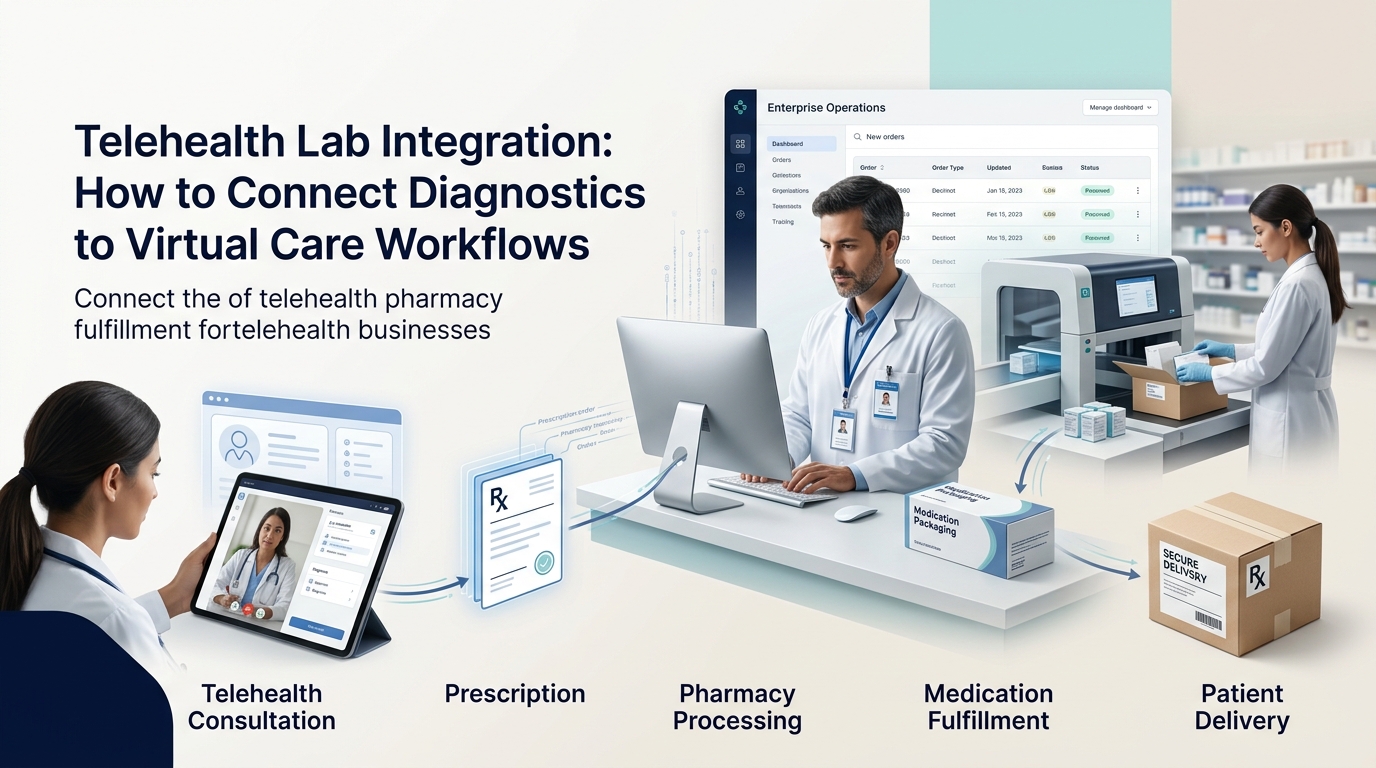
At its core, telehealth lab integration links four groups: clinicians, patients, collection channels, and laboratories. A complete setup usually covers:
- Lab ordering: clinicians place orders, often from predefined order sets, directly from the EHR or clinical platform.
- Collection: patients provide samples through at-home kits or at partner patient service centers.
- Processing: a CLIA-certified laboratory performs the testing and reports results.
- Results routing: results return electronically to the platform and the patient’s chart.
- Clinical review: the treating clinician reviews results before making or continuing treatment decisions.
- Patient communication: patients are notified about results and next steps in an appropriate way.
- Follow-up scheduling: repeat testing is ordered on the cadence the clinical protocol requires.
Each step depends on accurate data moving between systems. When any link is manual, delays and errors follow.
Why Diagnostics Matter So Much in Virtual Care
Lab work is the substitute for many things that would happen in a physical exam room. In an in-person practice, a clinician can draw blood during the visit or send the patient down the hall. In virtual care, testing must be arranged deliberately.
Diagnostics affect several outcomes operators care about:
- Service-line viability: some categories cannot run as telehealth programs without a dependable lab workflow.
- Clinical safety: baseline and monitoring labs help clinicians decide whether treatment is appropriate and whether it should continue.
- Speed to treatment: slow or confusing lab steps delay first prescriptions and frustrate patients.
- Retention: longitudinal programs depend on repeat labs being completed on time.
- Compliance posture: results used to support prescribing should come from certified labs, with documented clinician review.
Because of this, telehealth lab integration should be planned alongside clinical protocols, pharmacy fulfillment, and patient acquisition rather than added after launch.
Common Service Lines That Depend on Lab Work
Different categories rely on diagnostics in different ways. The table below gives a general view. Final lab panels should always be defined by each program’s medical director.
| Service line | Typical lab role (illustrative) |
|---|---|
| Weight loss & obesity medicine | Baseline metabolic panel, HbA1c or fasting glucose, lipid panel, TSH; pregnancy testing where applicable |
| Men’s health | Two morning total and free testosterone draws, LH/FSH, estradiol, PSA, CBC/hematocrit monitoring |
| Metabolic & cardiometabolic health | HbA1c, comprehensive metabolic panel, lipid panel, urine albumin-to-creatinine ratio |
| Women’s health / OB-GYN | FSH, estradiol, and TSH for menopause evaluation; STI testing where indicated |
| Dermatology | Liver function and lipids before and during certain systemic treatments; pregnancy testing per program rules |
| Longevity programs | IGF-1, hormone panels, CMP and CBC, depending on the protocol |
| Sleep health | TSH; iron studies when restless-leg symptoms are reported; sleep studies through referral |
| Urgent care | Rapid strep, flu/COVID antigen, and urinalysis through collection kits or local testing |
The pattern is clear: the more longitudinal and prescription-based a service line is, the more its success depends on diagnostics.
Collection Options: At-Home Kits vs. Partner Draw Sites
The collection channel is the most visible part of the lab experience for patients. Most operators use a mix of options.
| Collection option | Best suited for | Key considerations |
|---|---|---|
| At-home self-collection kits | Tests with an FDA-cleared or authorized home-collection pathway | Patient instructions, sample stability, shipping time, kit return rates |
| Partner patient service centers | Venous blood draws, fasting labs, and tests that require phlebotomy | Location coverage, scheduling, patient travel |
| Mobile phlebotomy | Patients who need a draw but cannot easily travel | Cost, availability by market, scheduling logistics |
| Local point-of-care testing | Acute care needs such as rapid strep | Usually arranged outside the telehealth platform |
At-Home Collection
At-home kits can make diagnostics remarkably convenient, but they are not appropriate for every test. Home collection should be used only where an FDA-cleared or authorized pathway exists for that specific test and collection method. Sample stability, return shipping, and clear instructions all affect whether a kit produces a usable result.
Operators should track kit activation and return rates closely. A kit that sits unopened in a patient’s kitchen delays care as surely as a missed appointment.
Partner Draw Sites
Many common monitoring tests, such as fasting panels, testosterone levels, and PSA, are typically collected by venipuncture. Partner patient service centers provide that capability across broad geographic areas. The operational challenge is making the hand-off seamless: the order must already be in the lab’s system when the patient arrives, and the patient needs clear instructions about fasting, timing, and identification.
How Standing Order Sets Simplify Clinical Workflows
One of the most useful components of a diagnostics workflow is the standing order set: a predefined group of tests tied to a specific service line or decision point.
Examples might include:
- A “weight loss initiation panel” ordered before a clinician considers pharmacotherapy.
- A “testosterone monitoring panel” ordered on a recurring cadence.
- A “metabolic follow-up panel” ordered at set intervals for chronic care programs.
Order sets offer several benefits:
- Consistency: every patient in a program receives the tests the protocol calls for.
- Speed: clinicians can trigger the right panel quickly after a visit.
- Fewer errors: predefined sets reduce missed or duplicated tests.
- Easier reporting: operators can track completion by panel and service line.
Order sets should be designed and approved by the medical director, reviewed regularly, and updated when clinical guidelines change. They support clinical judgment; they do not replace it. The treating clinician should still decide which tests are appropriate for each patient.
Results Routing and Clinical Review
Results are only valuable if the right person sees them at the right time. A well-designed results workflow typically includes:
- Electronic results delivery from the laboratory into the EHR or clinical platform, often through standard interfaces such as HL7.
- Queues or alerts that surface new and abnormal results for clinician review.
- Clear documentation of who reviewed each result and when.
- Patient notification that follows the program’s policies and applicable law.
- Release holds that keep related prescriptions or refills from moving to the pharmacy until required results are reviewed, where the protocol calls for it.
Patients also have rights to their results. Under HHS rules, individuals can generally request their test reports directly from HIPAA-covered laboratories. Your communication approach should account for that, and for how results and explanations reach patients through your platform.
Connecting Labs to Pharmacy Fulfillment
Telehealth lab integration and pharmacy fulfillment are closely linked. For many therapies, a prescription should not be issued, or a refill should not continue, until certain results are available and reviewed.
A connected workflow can:
- Prompt patients to complete labs before their next refill is due.
- Pause refill processing when monitoring labs are overdue, according to protocol.
- Show support teams whether a delay comes from the lab, the clinician, or the pharmacy.
- Resume fulfillment automatically once a clinician has reviewed results and approved continuation.
This coordination reduces manual follow-up and helps keep longitudinal programs on track. It also gives operators a clearer view of where patients are getting stuck.
Quality Standards: CLIA and Certified Laboratories
Laboratory quality is a foundational requirement. The Clinical Laboratory Improvement Amendments (CLIA), administered by CMS together with FDA and CDC, establish quality standards for laboratory testing performed on human specimens for health assessment, diagnosis, prevention, or treatment.
For telehealth operators, the practical implications include:
- Results used to support clinical or prescribing decisions should come from CLIA-certified laboratories.
- Lab partners should be able to provide documentation of their certification.
- The test menu, specimen requirements, and turnaround times should match your clinical protocols.
- A documented chain of custody and clinician review should be in place before prescriptions are released based on results.
Requirements can vary by state and service line and should be reviewed with appropriate medical, legal, and compliance professionals before launch. Some states also have their own laboratory licensing rules, which is another reason to involve counsel when expanding into new markets.
Privacy and Data Security for Lab Data
Lab results are among the most sensitive health information a telehealth company handles. Privacy planning should cover:
- HIPAA obligations: if your organization is a covered entity or business associate, laboratories, kit vendors, and integration partners that handle protected health information typically require business associate agreements where applicable.
- Tracking technologies: HHS Office for Civil Rights guidance addresses the use of online tracking tools on websites and apps of HIPAA-regulated entities. Pages that display results or lab scheduling deserve careful review.
- Non-HIPAA obligations: companies outside HIPAA may still be subject to the FTC’s Health Breach Notification Rule and state health privacy laws.
- Access controls: limit who can view results internally, and log access.
- Messaging: avoid exposing sensitive results in email subject lines, text previews, or other insecure channels.
A privacy review before launch is far easier than unwinding data flows after the fact.
Operational Metrics for Lab Workflows
Measuring diagnostics performance helps operators find bottlenecks before they affect patient outcomes.
| Metric | What it reveals |
|---|---|
| Order-to-collection time | How quickly patients complete testing after an order |
| Kit activation and return rate | Whether at-home kits are being used and returned |
| Collection-to-result time | Laboratory and shipping turnaround |
| Result-to-review time | Clinical capacity and queue management |
| Lab completion rate by service line | Where patients drop off before treatment |
| Rejected or unusable sample rate | Kit instructions, shipping, or collection quality issues |
| Overdue monitoring labs | Risk to refill continuity and protocol adherence |
A rising rejected-sample rate often points to unclear instructions or shipping problems rather than laboratory error. A long result-to-review time usually signals clinician capacity limits. Looking at these numbers by state and service line makes root causes easier to spot.
Building Diagnostics Infrastructure: In-House vs. Partner
Operators can build diagnostics infrastructure themselves or work with partners. Each path has trade-offs.
| Approach | Advantages | Challenges |
|---|---|---|
| Build in-house | Full control over vendors, interfaces, and data | Multiple contracts, interface builds, ongoing maintenance |
| Single lab partnership | Simpler relationship; one results feed | Coverage and test menu may not fit every service line |
| Integrated operating partner | Existing order sets, collection channels, and results routing | Requires clear clinical governance and contract terms |
Questions to ask when choosing an approach include:
- Which tests does each service line require, and can partners support all of them?
- Do at-home options exist with appropriate FDA clearance or authorization for those tests?
- How do results flow into your clinical platform?
- Can lab status connect to pharmacy fulfillment and refill logic?
- What documentation can partners provide on certification and quality?
For operators who prefer not to build every connection themselves, a B2B telehealth operating and growth partner such as TelePartners Studio treats telehealth lab integration as part of a broader operating model. That model connects standing order sets, at-home kits, partner draw sites, and results routing with provider network access, pharmacy fulfillment, and patient acquisition, while clinical decisions remain with independent licensed clinicians.
Common Mistakes in Telehealth Diagnostics
Even experienced operators can run into avoidable problems:
- Using at-home kits for tests without an appropriate FDA-cleared or authorized pathway.
- Sending results to email inboxes instead of structured clinical queues.
- Disconnecting lab status from refill logic, so patients run out of medication while waiting.
- Launching in markets where partner draw-site coverage is thin.
- Writing unclear patient instructions about fasting, timing, or sample collection.
- Skipping documentation of clinician review before prescriptions are released.
- Overlooking privacy on results pages and patient notifications.
A Readiness Checklist for Lab Integration
Before launching a lab-dependent service line, confirm the following:
- Lab panels and monitoring cadences are defined and approved by the medical director.
- Laboratory partners are CLIA-certified and documentation is on file.
- Collection options are available for every launch market.
- At-home kits are used only where an appropriate FDA pathway exists.
- Results flow electronically into clinician review queues.
- Refill and prescription release rules are tied to lab status where required.
- Patient instructions and notifications have been reviewed for clarity and privacy.
- Business associate agreements and vendor contracts are in place where applicable.
Frequently Asked Questions
What is telehealth lab integration?
Telehealth lab integration is the infrastructure that lets virtual care clinicians order lab tests, have patients complete collection through at-home kits or partner draw sites, and receive results back in their clinical workflow. It connects diagnostics with clinical review, patient communication, and, where relevant, pharmacy fulfillment.
Can patients complete all lab tests at home?
No. At-home collection is appropriate only for tests that have an FDA-cleared or authorized home-collection pathway. Many monitoring tests, such as fasting blood panels or testosterone levels, are typically collected by a phlebotomist at a partner patient service center or through mobile phlebotomy.
Why do telehealth labs need to come from CLIA-certified laboratories?
CLIA sets federal quality standards for laboratory testing on human specimens. Using CLIA-certified laboratories helps ensure that results used for diagnosis, treatment, or prescribing decisions meet those standards. Documentation of certification should be part of partner selection.
How do lab results connect to prescriptions in a telehealth program?
In a connected workflow, results route into the clinician’s review queue. The clinician reviews them before deciding to start or continue treatment, and refill processing can be held until required monitoring labs are reviewed. This alignment between telehealth lab integration and pharmacy fulfillment helps keep longitudinal programs safe and on schedule.
Which telehealth service lines rely most on diagnostics?
Weight loss, men’s health, metabolic and cardiometabolic care, and some dermatology and longevity programs depend heavily on baseline and monitoring labs. Urgent care and sleep health use diagnostics too, often through collection kits, local testing, or referral-based sleep studies.
Do patients have the right to receive their lab results directly?
Under HHS rules, individuals can generally request access to their test reports from HIPAA-covered laboratories. Telehealth operators should plan how results and explanations are communicated through their platform and make sure policies align with applicable federal and state requirements.
Conclusion
Lab work is one of the quiet foundations of virtual care. Many service lines are only practical as telehealth programs because a dependable diagnostics workflow fills the gap left by not seeing the patient in person. Effective telehealth lab integration brings together standing order sets, appropriate collection channels, CLIA-certified laboratories, electronic results routing, documented clinician review, and refill logic that respects monitoring requirements.
Operators who plan diagnostics alongside clinical protocols, pharmacy fulfillment, and patient acquisition launch faster and scale with fewer surprises. Start by mapping the labs each service line needs, confirm collection coverage in your target markets, and connect results to the decisions that depend on them.
If you are evaluating a lab-dependent service line, telehealth lab integration does not have to be built from scratch. TelePartners Studio works as a B2B telehealth operating and growth partner across patient acquisition, provider access, pharmacy fulfillment, and diagnostics, and a discovery call is a practical way to explore whether that operating model fits your plans.