Launching a virtual care company looks simple from the outside. A patient finds a brand online, completes an intake form, meets a clinician by video, and receives a prescription at home. Behind that experience, though, sits a chain of decisions about clinical structure, licensing, technology, pharmacy relationships, lab access, and compliant marketing. Get one link wrong and the whole model slows down or stalls.
If you want to start a telehealth business, the hardest part is rarely the website. It is building an operating model that holds up when real patients, real prescriptions, and real regulators are involved. Founders, healthcare entrepreneurs, medical groups, and consumer brands all run into the same core questions: Who employs or contracts the clinicians? Which states can we serve? How do prescriptions get filled? What labs are needed, and how do patients complete them without an office visit? How do we acquire patients without making claims we cannot support?
This guide walks through those questions in the order most operators face them when they start a telehealth business. It covers business model choices, corporate structure, provider networks, service-line selection, technology, pharmacy fulfillment, diagnostics, patient acquisition, and the compliance checkpoints that sit across all of them. It is written for decision-makers who want a realistic picture of what it takes, not a shortcut.
What a Telehealth Business Actually Includes
A telehealth company is not one product. It is a set of connected functions that must work together for every patient.
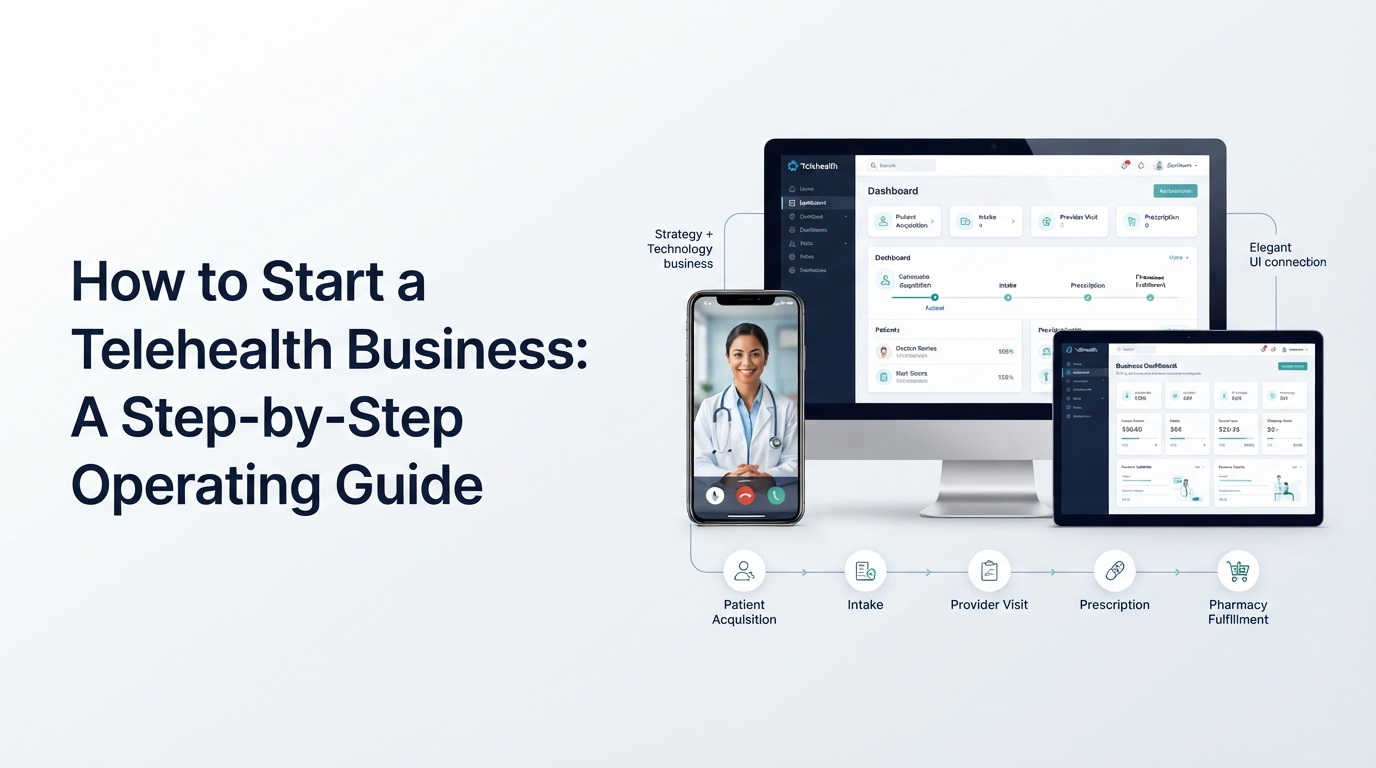
At a minimum, most direct-to-patient models include:
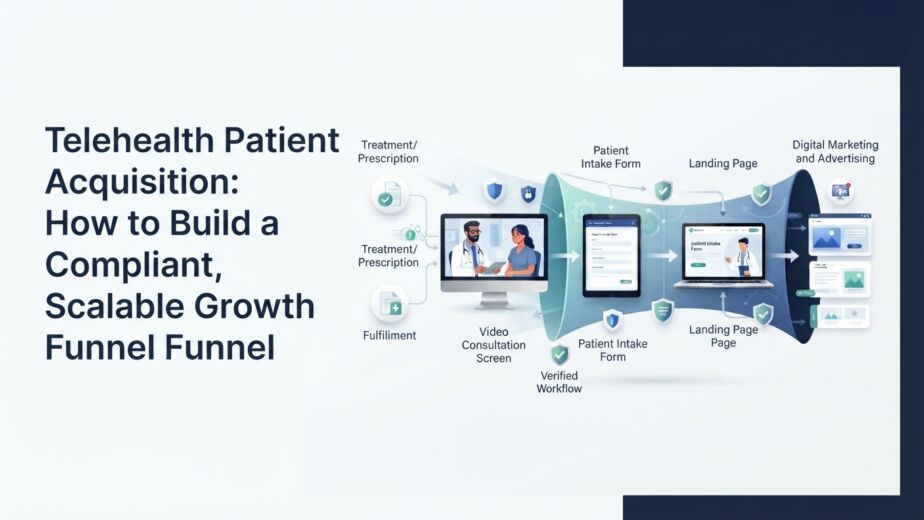
- Patient acquisition: content, paid media, landing pages, and conversion paths that bring the right patients in.
- Intake and checkout: health history, eligibility screening, consent, identity verification, and payment.
- Clinical care: licensed clinicians who evaluate patients by synchronous video, audio, or asynchronous review, depending on the service line and state rules.
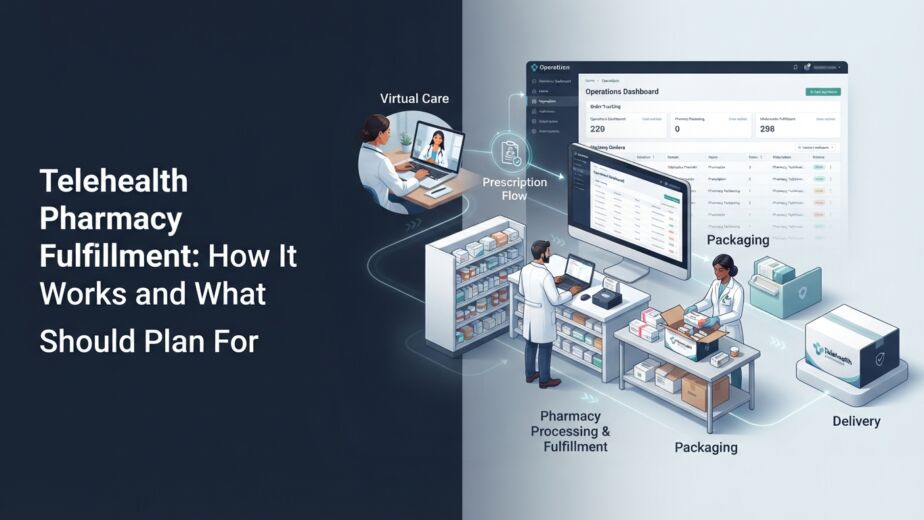
- Prescribing and fulfillment: e-prescribing to a licensed pharmacy that fills and ships medication when a clinician decides it is appropriate.
- Diagnostics: lab orders, at-home collection kits, or partner draw sites when a service requires testing.
- Follow-up and retention: refills, monitoring, messaging, and recurring visits.
- Compliance operations: privacy, licensing, prescribing rules, advertising review, and documentation.
When people say they want to start a telehealth business, they usually mean the patient-facing brand. The brand matters, but it depends on every function above being reliable. A useful early exercise is to write down who will own each function, whether you will build it, contract it, or partner for it, and how each hand-off will work.
Step 1: Choose Your Telehealth Business Model
The first strategic decision is how your company will relate to patients, clinicians, and payers.
| Model | How it works | Typical considerations |
|---|---|---|
| Direct-to-consumer (cash pay) | Patients pay directly for visits, programs, or memberships | Simpler billing; heavy reliance on marketing and conversion |
| Provider-led virtual practice | An existing practice adds virtual visits to its own patient base | Existing clinical infrastructure; growth limited by current reach |
| Brand or employer partnership | A non-clinical brand offers care through a licensed medical group | Requires a compliant structure separating brand and clinical decisions |
| Insurance-based virtual care | Visits billed to commercial plans or government programs | Credentialing, payer contracts, coding, and reimbursement rules |
Many new operators begin with a cash-pay, direct-to-patient model in a focused category because pricing is clearer and billing is simpler. Others add telehealth to an existing practice. There is no single right answer. The model should match your capital, your clinical relationships, and the patient population you can realistically reach.
Step 2: Set Up a Compliant Corporate Structure
Before you write a line of marketing copy, settle how the clinical side of the business will be owned and controlled.
Many states restrict non-physicians and lay entities from owning a medical practice or controlling clinical decisions. This doctrine is generally called the corporate practice of medicine. Its scope and enforcement vary considerably by state.
A common response is a two-entity structure:
- A professional entity (often a physician-owned medical group) that employs or contracts licensed clinicians and is responsible for patient care.
- A management services organization (MSO) that provides non-clinical services such as technology, marketing, billing support, and operations under a services agreement.
The key principle is that clinical decisions stay with licensed clinicians. A marketing team, a technology platform, or a product list should never dictate whether a patient receives a prescription. That separation protects patients, and it protects the business.
Structure, fee arrangements, and contracts should be designed with experienced healthcare regulatory counsel. Requirements can vary by state and service line and should be reviewed with appropriate medical, legal, and compliance professionals before launch.
Step 3: Pick Your First Service Line Carefully
Trying to launch every category at once is one of the most common early mistakes teams make when they start a telehealth business. Each service line has its own clinical protocols, lab needs, medication classes, and regulatory profile. A focused first launch lets you prove the operating model before you scale it.
When you evaluate categories, compare them on factors like these:
- Patient demand and search interest in your target markets.
- Clinical complexity, including how often in-person care or testing is needed.
- Lab requirements before and during treatment.
- Controlled-substance exposure, which adds federal and state prescribing rules.
- Compounding exposure, which depends on FDA shortage and bulk-substance determinations.
- Recurring care potential, since longitudinal programs support retention.
Here is a simplified view of how common categories differ:
| Service line | Typical operational profile |
|---|---|
| Weight loss & obesity medicine | High demand; baseline labs and contraindication screening; some options are controlled substances |
| Dermatology, skin & hair | Photo-based intake works well; most topical regimens need no labs; isotretinoin requires a hybrid pathway |
| Men’s health | Strong demand; testosterone is a Schedule III controlled substance; recurring lab monitoring |
| Women’s health / OB-GYN | Contraception and menopause care; documented contraindication screening before estrogen products |
| Urgent care | High volume, low complexity; depends on strict triage and escalation protocols |
| Sleep health | Insomnia care plus referral pathways; some medications are controlled substances |
Your first category should be one your clinical leadership is comfortable supervising, your pharmacy partners can support, and your marketing team can promote within advertising rules. Once the workflow is stable, adding categories becomes much more efficient because they can share the same funnel, provider network, and pharmacy relationships.
Step 4: Build or Access a Licensed Provider Network
Clinicians must generally be licensed in the state where the patient is located at the time of the visit. That rule shapes nearly every growth decision.
Practical options include:
- Employing clinicians directly through your professional entity.
- Contracting with independent clinicians on a per-visit or hourly basis.
- Partnering with an existing provider network that already holds multistate licenses.
Licensure compacts can help. The Interstate Medical Licensure Compact offers eligible physicians an expedited pathway to licensure in participating states, and similar compacts exist for nurses and other professions. A compact still results in individual state licenses, so it does not remove state requirements.
Beyond licensure, plan for credentialing, malpractice coverage, clinical protocols, quality review, and scheduling capacity. If you start a telehealth business in several states at once, patient demand can arrive faster than providers can be licensed, so capacity planning belongs in your launch timeline from the start.
Step 5: Design Clinical Workflows and Protocols
Clinical protocols turn good intentions into consistent care. They define what happens at each stage of the patient journey and when a patient should be referred elsewhere.
A typical workflow looks like this:
- Intake: structured health history, medication list, allergies, and service-specific screening questions.
- Eligibility and red flags: rules that route patients to in-person or emergency care when symptoms are outside telehealth scope.
- Visit modality: synchronous video, audio, or asynchronous review, based on state rules and clinical need.
- Labs: baseline testing ordered before treatment where the protocol calls for it.
- Clinical decision: the treating clinician decides independently whether treatment is appropriate.
- Prescription and fulfillment: e-prescription to a licensed pharmacy.
- Follow-up: monitoring, refills, and repeat labs on a defined cadence.
Protocols should be written and signed off by your medical director, reviewed regularly, and updated when guidelines or regulations change. Documentation matters as much as the decision itself.
Step 6: Select a Compliant Technology Stack
Telehealth technology should support the clinical workflow, not drive it. Most operators need several connected components:
- An electronic health record (EHR) or clinical charting system.
- A video and messaging platform suitable for protected health information.
- An intake and checkout flow with consent capture and payment processing.
- E-prescribing, including electronic prescribing of controlled substances if your service line requires it.
- Lab ordering and results integration.
- A customer relationship and support system.
Privacy deserves early attention. If your organization is a HIPAA covered entity or business associate, vendors that handle protected health information typically need business associate agreements. The HHS Office for Civil Rights has also issued guidance on online tracking technologies, such as analytics pixels, on websites and apps operated by HIPAA-regulated entities. Companies outside HIPAA may still be subject to the FTC’s Health Breach Notification Rule and state privacy laws. Map your data flows before you install marketing tags on intake pages.
Step 7: Arrange Pharmacy Fulfillment
Prescription-based service lines need reliable pharmacy relationships. Fulfillment affects patient experience, refill retention, and compliance exposure.
Key decisions include:
- Pharmacy type: retail, mail-order, or compounding pharmacies, depending on the medications involved.
- State licensing: pharmacies that ship across state lines generally need appropriate licensure in the states they serve.
- Compounding rules: compounded medications should come only from properly licensed 503A pharmacies or registered 503B outsourcing facilities, in line with current FDA policy.
- Order routing and status updates: how prescriptions move from your platform to the pharmacy, and how patients receive shipping and refill updates.
Compounding requires particular care. FDA has determined that the national shortages of tirzepatide and semaglutide injection products are resolved, and it has clarified how its compounding policies apply as supply stabilizes. Programs built around compounded versions of shortage drugs need current legal review rather than assumptions carried over from earlier periods.
Step 8: Integrate Diagnostics and Lab Work
Many service lines are only telehealth-viable because a lab workflow fills the gap left by not seeing the patient in person. Weight loss programs often need metabolic panels before therapy. Testosterone therapy needs confirmatory morning testosterone draws and ongoing hematocrit monitoring. Some dermatology treatments require repeat liver and lipid testing.
A strong diagnostics layer usually includes:
- Standing order sets by service line that a clinician can trigger after a visit.
- At-home collection kits where an FDA-cleared or authorized home-collection option exists for the analyte.
- Partner draw sites for tests that require phlebotomy.
- Results routing into the EHR so that clinicians review results before releasing related prescriptions.
Results used to support prescribing decisions should come from CLIA-certified laboratories. CLIA, administered by CMS, sets quality standards for laboratory testing performed on human specimens.
Step 9: Plan Patient Acquisition and Brand Positioning
A telehealth company competes for attention in crowded search results and social feeds. Patient acquisition should be planned as a system, not a series of ad campaigns.
The core pieces usually include:
- Search-focused content that answers real patient questions for each service line.
- Paid social and search campaigns with creative reviewed before launch.
- Dedicated landing pages for each category, with clear expectations about how care works.
- Conversion tracking that respects privacy rules.
- Lifecycle messaging that supports refills and follow-up.
Healthcare advertising carries extra responsibility. The FTC’s Health Products Compliance Guidance explains that health-related claims generally need competent and reliable scientific evidence. Prescription product promotion can also raise FDA and state-specific issues. Build a review step into your creative process so that claims, testimonials, and before-and-after content are checked before they go live.
Step 10: Account for Controlled-Substance Rules
Some popular categories involve controlled substances. Testosterone is Schedule III. Phentermine and phentermine combinations are Schedule IV. Common sleep medications such as zolpidem and eszopiclone are also Schedule IV.
Federal law has historically required an in-person medical evaluation before controlled substances are prescribed via the internet, with limited exceptions. DEA and HHS have extended pandemic-era telemedicine flexibilities through December 31, 2026, while permanent rules continue to develop. States can add their own requirements, such as synchronous audio-video visits or periodic in-person exams.
Because these rules are time-limited and changing, controlled-substance service lines should be reviewed with counsel before launch and monitored closely after.
Startup Costs and Timeline Considerations
What it costs to start a telehealth business differs for every operator, and published cost figures vary widely, so it is more useful to plan by category than to rely on a single number. Expect spending across these areas:
- Legal structuring, contracts, and regulatory review.
- Clinical leadership, provider compensation, and licensure.
- Technology platforms and integrations.
- Pharmacy and lab partner setup.
- Brand, website, content, and paid media.
- Customer support and operations staff.
- Insurance, including malpractice and cyber coverage.
Timelines depend heavily on licensing, structuring, and partner onboarding. Building every function in-house usually takes the longest. Partnering for infrastructure, such as provider access, pharmacy fulfillment, and lab integration, can shorten the path to a first patient, though it still requires careful contracting and oversight.
Build In-House or Partner? A Practical Comparison
| Function | Build in-house | Partner |
|---|---|---|
| Provider network | Full control; slow multistate licensing | Faster access to licensed clinicians; requires clear clinical governance |
| Pharmacy fulfillment | Rarely practical for new operators | Established licensing, shipping, and refill workflows |
| Lab integration | Complex vendor and interface work | Existing order sets, kits, and results routing |
| Marketing and funnel | Strong brand ownership | Specialized healthcare advertising experience |
| Compliance workflows | Deep internal expertise required | Shared frameworks, still reviewed by your own counsel |
Many companies land on a hybrid. They own the brand and patient relationship while partnering for the infrastructure that is expensive to replicate. This is the space where a B2B telehealth operating and growth partner such as TelePartners Studio works, supporting patient acquisition, provider network access, telehealth operations, pharmacy fulfillment, and lab integration while clinical decisions remain with independent licensed clinicians.
Common Mistakes to Avoid
Even well-funded operators run into avoidable problems. The most frequent include:
- Launching too many categories at once before one workflow is proven.
- Letting marketing drive clinical decisions, such as promising a specific prescription.
- Ignoring state-by-state rules for licensure, prescribing, and visit modality.
- Installing tracking pixels on intake pages without a privacy review.
- Treating compounding as a permanent option without checking current FDA status.
- Skipping escalation protocols for symptoms that require in-person care.
- Underestimating support volume around shipping, refills, and billing questions.
A Launch Readiness Checklist
Before your first patient visit, confirm that you can answer yes to these questions:
- Is the corporate structure reviewed by healthcare counsel for each launch state?
- Are clinical protocols written and signed by a medical director?
- Are clinicians licensed in every state you will serve?
- Are pharmacy and lab partners contracted, licensed, and integrated?
- Have privacy practices, vendor agreements, and tracking tools been reviewed?
- Has all marketing copy been checked against advertising rules?
- Are escalation and referral pathways documented?
- Is support staffed for intake, shipping, and refill questions?
Frequently Asked Questions
Do I need to be a doctor to start a telehealth business?
Not necessarily. Non-physician founders often start a telehealth business by partnering with a physician-owned medical group under a management services arrangement. Clinical care must be delivered and controlled by licensed clinicians, and many states restrict lay ownership of medical practices, so the structure should be reviewed by healthcare counsel.
How long does it take to launch a telehealth company?
It depends on structuring, licensing, technology, and partner onboarding. Companies that build every function themselves usually need the most time. Partnering for provider access, pharmacy fulfillment, and lab integration can shorten the timeline, but contracts, protocols, and compliance review still take careful work.
Which telehealth service line is best to launch first?
There is no universal answer. Weight loss, dermatology, men’s health, and women’s health are common starting points because demand is strong and workflows are well understood. The right choice depends on your clinical leadership, your target states, the lab and pharmacy support available, and how much controlled-substance or compounding exposure you are comfortable managing.
Can a telehealth company operate in all 50 states?
It can, but only with clinicians licensed in each state where patients are located and with pharmacy partners licensed to ship there. Prescribing, visit-modality, and corporate practice rules also vary by state. Most operators expand state by state rather than launching nationally on day one.
What compliance areas matter most when I start a telehealth business?
Corporate practice of medicine, state licensure, prescribing rules (especially for controlled substances), privacy and data security, compounding status, lab quality requirements, and advertising claims are the main areas. Requirements can vary by state and service line and should be reviewed with appropriate medical, legal, and compliance professionals before launch.
Do I need my own pharmacy?
Most new operators do not. They contract with licensed pharmacies that already have state licenses, shipping operations, and refill workflows. Compounded products should come only from properly licensed 503A pharmacies or registered 503B outsourcing facilities in line with current FDA policy.
Conclusion
The decision to start a telehealth business is really a decision to run several connected operations at once: clinical care, licensing, technology, pharmacy fulfillment, diagnostics, patient acquisition, and compliance. Successful operators treat these as one system. They choose a focused first service line, put a compliant clinical structure in place, secure licensed providers and dependable fulfillment partners, and market within clear advertising rules.
If you plan to start a telehealth business, begin with the operating model rather than the logo. Map each function, decide what you will build and what you will partner for, and involve medical and legal professionals early. Once one service line runs smoothly, the same infrastructure can support additional categories with far less effort.
For teams that want to launch or expand without building every layer from scratch, TelePartners Studio works as a B2B telehealth operating and growth partner across patient acquisition, provider access, operations, pharmacy fulfillment, and lab integration. If you are evaluating a new service line, a discovery call is a practical next step to see whether the model fits your goals.